What this guide covers
This is a plain-English summary of smoke and carbon monoxide alarm duties for domestic private landlords in England: what to fit, where, testing at tenancy start, and how to keep records. We also point to good practice and how LetCompliance can help you log test dates per property. It is not legal advice. Scotland, Wales and Northern Ireland have different rules. Check with your council, especially for HMO licences.
Smoke alarms: what English law expects
The Smoke and Carbon Monoxide Alarm (England) Regulations (as amended) set baseline duties for specified tenancies in England. In outline, landlords must ensure:
Alarms must be in working order at the start of a new tenancy (and when replacement tenancies begin, depending on the facts). Local authorities can impose civil penalties for breaches, treat compliance as non-negotiable.
Practical placement: Smoke alarms are usually on ceilings in hallways and landings serving sleeping areas, and on each storey. Follow manufacturer instructions and British Standard guidance where applicable. Interlinked alarms are increasingly common in new builds and retrofits; older stock may have standalone units, both can be compliant if correctly installed and maintained.
Carbon monoxide (CO) alarms: when landlords need them
CO alarms protect against faulty or poorly ventilated combustion equipment. In England, the regulations focus on rooms with fixed combustion appliances (again, excluding gas cookers only under current rules). Oil, solid fuel, and gas appliances that fall in scope need an alarm in that living room.
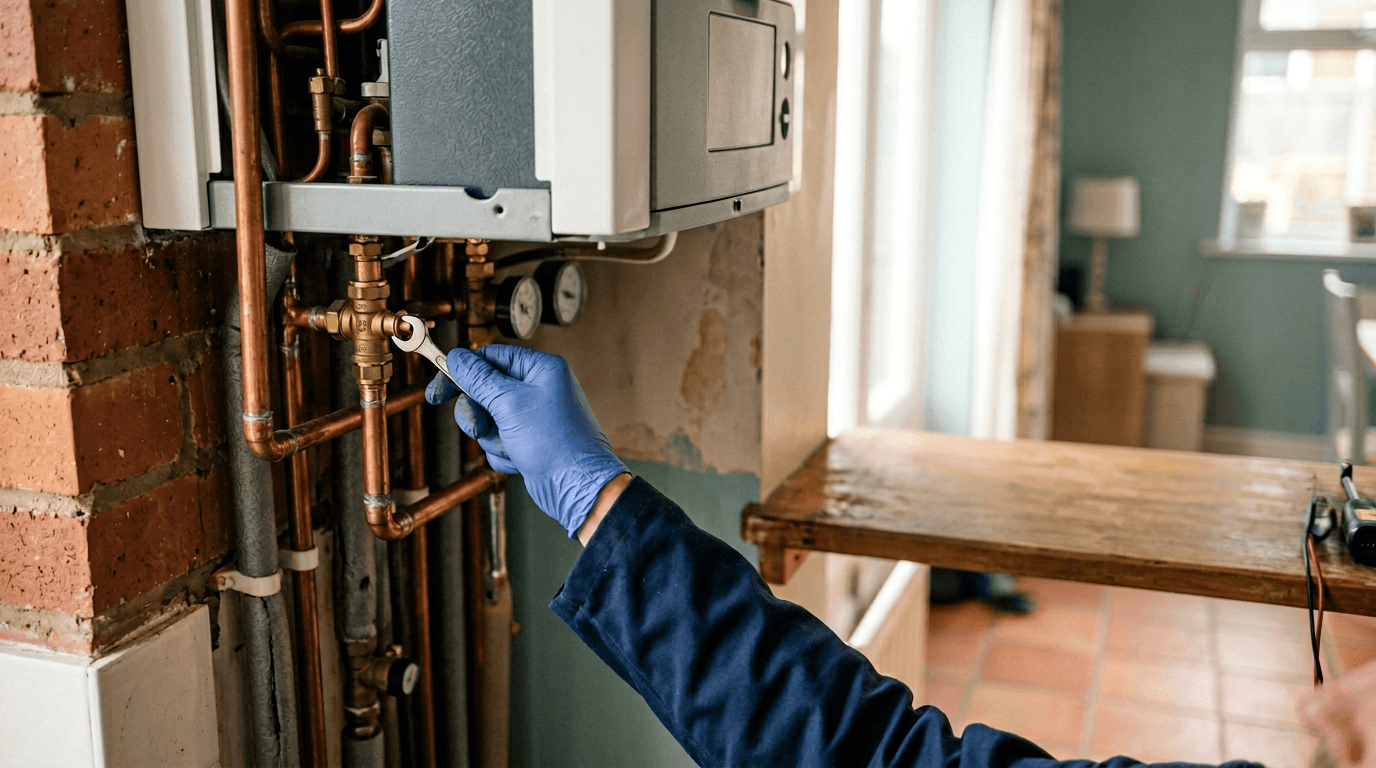
Good practice beyond the minimum: Many landlords also fit CO alarms near boiler cupboards or utility areas if a fixed appliance is present, and document installation dates and battery types. Sealed long-life batteries reduce tenant “battery removal” issues.
Not a substitute for Gas Safety: A Gas Safety Certificate (CP12) is still annual and separate. CO alarms add early warning; they do not replace servicing and Gas Safe checks. See our Gas Safety certificate guide.
Testing: landlord vs tenant responsibilities
At tenancy start, the landlord should ensure alarms work (many landlords test in front of the tenant and note the date). During the tenancy, tenants are typically expected to replace batteries where user-replaceable, but the landlord must repair or replace faulty alarms when notified. If a tenant reports a chirping or dead alarm, treat it as urgent.
Suggested rhythm: Weekly pressing the test button where realistic (often cited in fire safety messaging), plus a record at check-in, renewal, and property visits. HMOs and licensed properties may need more frequent documented checks, see our HMO compliance guide.
HMOs, selective licensing and fire risk
Houses in multiple occupation (HMOs) often face extra rules: licence conditions, Fire Risk Assessments, escape routes, and alarm types (interlinked, mains-powered, etc.). A generic domestic alarm kit may not be enough for a large HMO. Always align with your council and LACORS / BS 5839 guidance where relevant.
If you already track Fire Risk Assessment renewal in LetCompliance, adding per-alarm notes and next test dates in one place reduces the risk of nothing being checked between tenancies.
Where the evidence should live
Everything above comes down to one thing: on the day it matters, can you produce a dated record. LetCompliance gives each property a Safety area where alarms are listed individually — “First-floor landing smoke”, “Kitchen CO” — with test dates, notes and a one-tap “Log test today”, so the check-in test and every later report become an audit trail instead of a memory.
That sits inside a platform that runs the whole let, not a safety checklist bolted onto a spreadsheet: advertising and applications, referencing, e-signed tenancies, rent collection with arrears chasing, maintenance work orders with completion evidence, gas, electrical and EPC dates scored 0–100 across the portfolio, Section 8 and Section 13 notices, and an SA105 tax pack at year end.
It does not replace professional installation or the regulations themselves. It replaces the version of this where the evidence lives in your head.
Related: PAT testing for landlords, 2026 compliance checklist.
The 2022 amendment: what actually changed
The rules landlords quote are usually the 2015 version. The current law is the 2015 Regulations as amended by the Smoke and Carbon Monoxide Alarm (Amendment) Regulations 2022, in force from 1 October 2022, and the amendment changed two things that matter.
Carbon monoxide alarms became far broader. The 2015 rule only caught rooms with a solid fuel appliance, so most landlords never needed one. Since October 2022 a CO alarm is required in any room used as living accommodation that contains a fixed combustion appliance, which brings in gas boilers, gas fires and oil-fired systems. Gas cookers are excluded.
That single change is why so many properties are quietly non-compliant. A flat with a gas boiler in the kitchen needed no CO alarm in 2021 and needs one now.
Repair became an express duty. The landlord must repair or replace an alarm found to be faulty, once informed. It is no longer enough to have installed working alarms at the start of the tenancy.
The obligations in plain terms
The regulations do not specify alarm type, so battery units are lawful. Sealed ten-year lithium alarms are worth the extra few pounds because they remove the removed-battery failure mode entirely, which is the most common reason an alarm is dead when it is needed.
Position them properly: smoke alarms on the ceiling, central to a hallway or landing, and CO alarms at head height roughly one to three metres from the appliance, following the manufacturer's instructions. A CO alarm sitting in a drawer because it was never mounted is legally an alarm you do not have.
Enforcement, and what it costs to get wrong
The local authority enforces. Where it has reasonable grounds to believe you are in breach it serves a remedial notice giving 28 days to comply, counted from the day it is served. You can make written representations inside that window, which suspends the notice while they are considered. Ignore it and the council can arrange the work itself with the tenant's consent, and impose a civil penalty of up to £5,000.
Two details that change the arithmetic. First, GOV.UK's guidance for local authorities is explicit that the penalty applies per breach, not per landlord or per property, so a three-storey house missing alarms on two floors is not automatically one £5,000 question. Second, you are not without a route back: you can request a written review, and if the penalty is confirmed or varied you can appeal to the First-tier Tribunal, which suspends the penalty until the appeal is determined.
Some tenancies are outside the regulations entirely, and it is worth knowing whether yours is: accommodation shared with the landlord or the landlord's family, long leases, student halls of residence, hotels and refuges, care homes, hospitals and hospices, and certain low-cost ownership and healthcare accommodation. Note that "student halls of residence" means halls, not an ordinary student house let on an assured tenancy — a shared student house in the private sector is squarely inside these rules.
The £5,000 is not the real exposure. Consider the sequence a landlord faces after a fire or a CO incident: an insurer examining whether the alarm requirements were met before paying a claim, a coroner or an HSE investigation asking the same, and a tenant with a straightforward negligence case. Set against an alarm costing £25 and a photograph, the risk is absurdly one-sided.
A worked example. A tenant reports a beeping smoke alarm in February by text message. The landlord means to deal with it, the message scrolls out of view, and nothing happens. In November there is a kitchen fire. The alarm is found to be non-functioning, and the February text is produced. The landlord had one clear duty — repair once informed, and there is a dated record proving he was informed and a nine-month gap proving he did not act.
Nothing about that outcome required bad intent. It required a report that lived in a text thread instead of a system.
Building the evidence, not just the alarms
Compliance here is almost entirely evidential. The alarms are cheap and the installation is simple; what people lose on is proving the position on a specific date.
Three habits cover it:
Test at check-in and record it. Photograph each alarm in place, test it, and have the tenant sign the inventory or check-in report to confirm every alarm was working on day one. That single signed line resolves most disputes before they start.
Give the tenant the routine in writing. Monthly testing during the tenancy is the tenant's responsibility, and saying so at the start — with a note that faults must be reported to you — makes the division of duty clear and evidenced.
Log every report and every response, with dates. A reported fault, the date you were told, what you did, and when. This is the record that decides the February-text scenario above, and it is the one that most often does not exist.
Related: PAT testing for landlords, 2026 compliance checklist.
2026 UK Landlord Compliance Cheat Sheet
Every Gas Safety, EICR, EPC, deposit and Right to Rent deadline on one printable A4 page. Updated for the Renters’ Rights Act 2025.
- Every UK statutory deadline by document type
- Maximum penalty per breach (HSE, MEES, RtR, deposit)
- What blocks a Section 8 / Form 6A possession claim
- Print-friendly A4 with checkboxes
Frequently asked questions
How many smoke alarms does a landlord need in England?
Regulations require at least one smoke alarm on every storey used as living accommodation, and a carbon monoxide alarm in any room with a fixed combustion appliance (other than gas cookers only, per the current English rules). HMOs and licensed properties may have extra local requirements, check your council.
Where exactly should I place a carbon monoxide alarm in a rental property?
Fit a CO alarm in any room used as living accommodation that contains a fixed combustion appliance. That covers: gas boilers, gas fires, wood-burning stoves, coal fires, oil-fired boilers and solid-fuel heaters. Gas cookers and gas hobs are currently excluded from the mandatory regulation in England — but manufacturers and the HSE recommend fitting one nearby anyway. Place the alarm at head height on the wall, 1–3 metres from the appliance (follow the manufacturer's spec), never in dead air pockets, behind curtains, or directly above the appliance.
Do smoke alarms need to be interlinked in England for private rentals?
No — interlinked alarms are not currently required by law for private rentals in England (this is a Scotland-only mandatory rule under the Tolerable Standard since 1 February 2022). However, interlinked alarms are best practice for HMOs, larger properties, and any new install — when one alarm sounds, all sound, giving tenants more escape time. Selective licensing schemes and Awaab's Law investigations may also push you toward interlinked systems on risk grounds.
How do landlords test smoke and carbon monoxide alarms at the start of a tenancy?
Press and hold the test button on every alarm on the day the tenant moves in (or the working day immediately before). Confirm the alarm sounds for at least 3–5 seconds. Photograph or video the test with a timestamp and store it in your tenancy file. Get the tenant to sign an acknowledgement that all alarms were tested and working — many councils now ask to see this evidence during licensing inspections, and it's your defence if a fire claim ever arises.
Do landlords have to test smoke alarms for tenants?
The law expects alarms to be in working order at the start of a tenancy. Tenants are usually responsible for replacing batteries during the tenancy, but landlords should repair or replace faulty alarms when notified. Good practice is to test on check-in and document it.
What is the fine for not having smoke or CO alarms in a rental?
The local authority can issue a remedial notice giving you 28 days to fix the breach. Failure to comply can result in a civil penalty of up to £5,000 per property (set out in the Smoke and Carbon Monoxide Alarm (England) Regulations 2015, as amended in 2022). Repeated breaches can stack across a portfolio. Tracking alarm install + test dates per property is the simplest way to avoid this.